From AI to Agents: How MCPs Are Changing the Game for Small Businesses

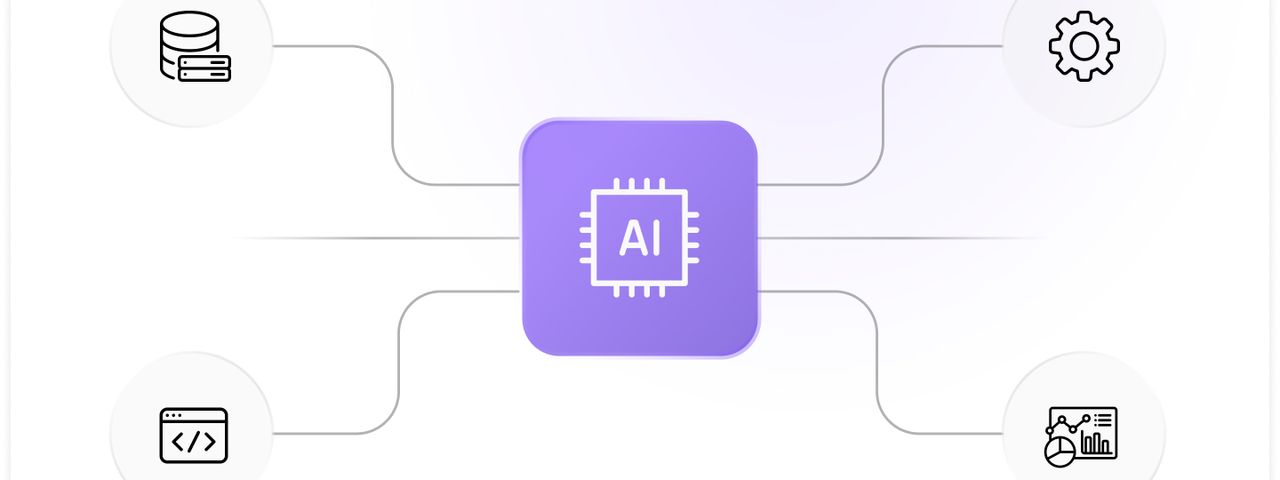
Generative AI gave small businesses a voice. AI Agents give them execution. Here is a technical breakdown of how Agents and MCP work and why custom-built architecture is the only version that actually compounds.
The shift nobody warned you about
A year ago, the conversation was about generative AI tools that write, generate, and create on demand. That was the first wave. The second wave is already here, and it operates on a different principle entirely.
AI Agents don't generate. They act. Model Context Protocol (MCP) doesn't assist. It integrates. Together, they represent a shift from AI as a productivity aid to AI as an operational layer one that executes workflows, connects systems, and makes decisions at machine scale.
For small businesses, understanding this shift is not optional. It is the difference between adopting AI that makes you slightly more efficient and building AI that makes you structurally harder to compete with.
This is a breakdown of how it works and why the architecture matters more than the tooling.
Framework 1: What is an AI Agent?
Generative AI responds. An AI Agent acts.
The distinction is architectural. An agent is not a smarter chatbot it is a system designed to perceive its environment, reason about it, and take action in the world. Every agent operates across three layers:
- Perception: The agent ingests inputs from its connected environment: emails, database records, API responses, calendar entries, support queues
- Reasoning: It applies a model to evaluate context, weigh options, and determine the optimal next step
- Action: It executes: writes to a database, sends a message, calls an API, triggers another agent, or escalates to a human
What makes agents fundamentally different from earlier AI is autonomy over a task horizon. A generative AI completes a single prompt. An agent completes a goal which may require multiple steps, tool calls, and decision branches before it resolves.
A practical illustration: ask a generative AI to draft a follow-up email and it will. An agent given the same goal will first check the CRM for the last interaction, assess the deal stage, look up any open support tickets, determine the appropriate tone and urgency, draft the email, send it, log the activity, and schedule a follow-up check all as a single goal-driven execution. Same output. Entirely different system.
Framework 2: What is MCP?
An agent without data connectivity is an island. Model Context Protocol is the bridge.
MCP is an open standard introduced by Anthropic in late 2024 and now widely adopted that defines how AI agents connect to external tools, services, and data sources. In architectural terms, it is a standardized server-client protocol: your business systems expose MCP servers, and your agents consume them as MCP clients.
Think of it the way REST standardized how web services communicate. MCP does the same for AI-to-tool communication providing a consistent, secure, schema-aware interface regardless of what system sits behind it.
What this means in practice:
- An MCP server in front of your CRM lets your agent query customer history, update records, and trigger workflows with full awareness of your actual data schema
- An MCP server wrapping your inventory system gives your agent real-time stock visibility and write access for reorder actions
- An MCP server on your internal knowledge base lets your agent reason against your own operational documentation rather than general training data
Without MCP, agents make static API calls fragile, narrow, and expensive to maintain. With a well-designed MCP layer, agents become context-aware, data-rich, and operationally reliable. The MCP layer is what transforms an AI experiment into a production business system.
Framework 3: The Agent & MCP Workflow Loop
These two components compose into a repeatable operational pattern a loop that handles work autonomously and improves over time.
Goal → Perception → Reasoning → Action
- Goal: A trigger fires a new lead enters the CRM, a stock level drops below threshold, a support ticket exceeds SLA
- Perception: The agent reads relevant context via its MCP connections customer history, current inventory, ticket priority, account tier
- Reasoning: The model evaluates the situation against defined logic what action is appropriate? Does this need escalation? What is the right output given the full context?
- Action: The agent executes via MCP updates a record, sends a message, triggers a downstream process, logs the outcome
This loop is not novel in concept rule-based automation has always followed trigger → action patterns. What agents add is reasoning at the decision layer: the ability to handle ambiguity, weigh context, and navigate situations that simple if/then logic cannot.
That is the architectural leap. And it is precisely why the implementation matters as much as the concept.
The ceiling of generic tooling
The market has responded to agent momentum with a flood of platforms automation builders, agent frameworks, no-code orchestrators. For common, linear workflows they deliver value. For anything more complex, they share a fundamental ceiling.
Generic platforms are built on lowest-common-denominator assumptions. They assume your data lives in a standard schema. They assume your workflow fits a predefined template. They assume your business logic is expressible in a visual node editor with a finite set of conditions.
The moment your process has a legitimate exception a pricing model that varies by customer relationship, an escalation path that depends on contract terms, a fulfilment rule tied to supplier-specific lead times generic tooling forces a choice: simplify your process to fit the tool, or abandon the automation.
This is not a feature gap. It is an architectural constraint. Generic platforms cannot encode domain-specific reasoning because they were not designed with your domain in mind. They abstract away the very specificity that makes your operations valuable.
There is also a strategic dimension worth naming directly: every business on the same platform runs the same logic. Automation becomes a commodity. The efficiency gain is real, but it is equally available to every competitor who signs up for the same subscription.
What custom architecture actually means
Custom-built Agents and MCPs are not simply more expensive automation. They are a different category of system entirely.
Custom MCP servers expose your actual data schemas not a normalized abstraction of them. Your agent reasons against real field names, real relationships, real business objects. It does not approximate what "customer" or "order" means in your context. It knows, because you defined it.
Custom reasoning layers encode your business rules at the logic level. Approval thresholds, exception handling, customer tiering, escalation criteria these become first-class citizens of the agent's decision-making, not workarounds added afterward.
Custom tool definitions give agents precise, scoped instructions for interacting with your systems what to read, when to write, what to never modify. This precision is what makes agents genuinely trustworthy in production rather than a liability risk.
Context and memory architecture determines what an agent retains across sessions: conversation history, past decisions, customer preferences, outcomes of prior actions. Designed well, an agent accumulates operational context that makes every subsequent interaction more accurate than the last.
The result is an agent that behaves the way your most experienced employee would not as a simulation, but as an encoding of their judgment, running at machine scale, around the clock.
The compounding argument
The strongest case for custom architecture is not the initial capability gap. It is what happens over time.
Generic platforms improve for all their customers equally. A custom agent improves for your specific operations. Every edge case encountered, every exception logged, every business rule refined becomes institutional knowledge embedded in the system. The agent gets better as your understanding of your own operations deepens.
This is the compounding advantage: a custom AI system running for eighteen months reflects eighteen months of operational learning. That learning cannot be replicated by a competitor who subscribes to the same platform you just evaluated.
For small businesses where competitive advantage lives in operational knowledge, customer relationships, and the judgment accumulated over years this matters enormously. Custom Agents and MCPs are the mechanism for encoding that advantage at scale, rather than leaving it locked in spreadsheets and institutional memory that walks out the door.
Where to start
The right entry point is almost always the narrowest one. Identify the workflow with the clearest trigger, the most predictable output, and the highest friction cost. Build one agent. Connect one MCP server. Run the loop. Measure the outcome. Then expand.
The technical investment is real, but it is front-loaded. The operational leverage compounds from day one.
Generative AI gave small businesses access to content at scale. Agents give them execution at scale. The businesses investing in custom AI infrastructure now are not just automating tasks they are building a layer of operational intelligence that grows more valuable with every cycle it runs.
That is the shift worth understanding. And the sooner the architecture is right, the sooner it starts compounding.